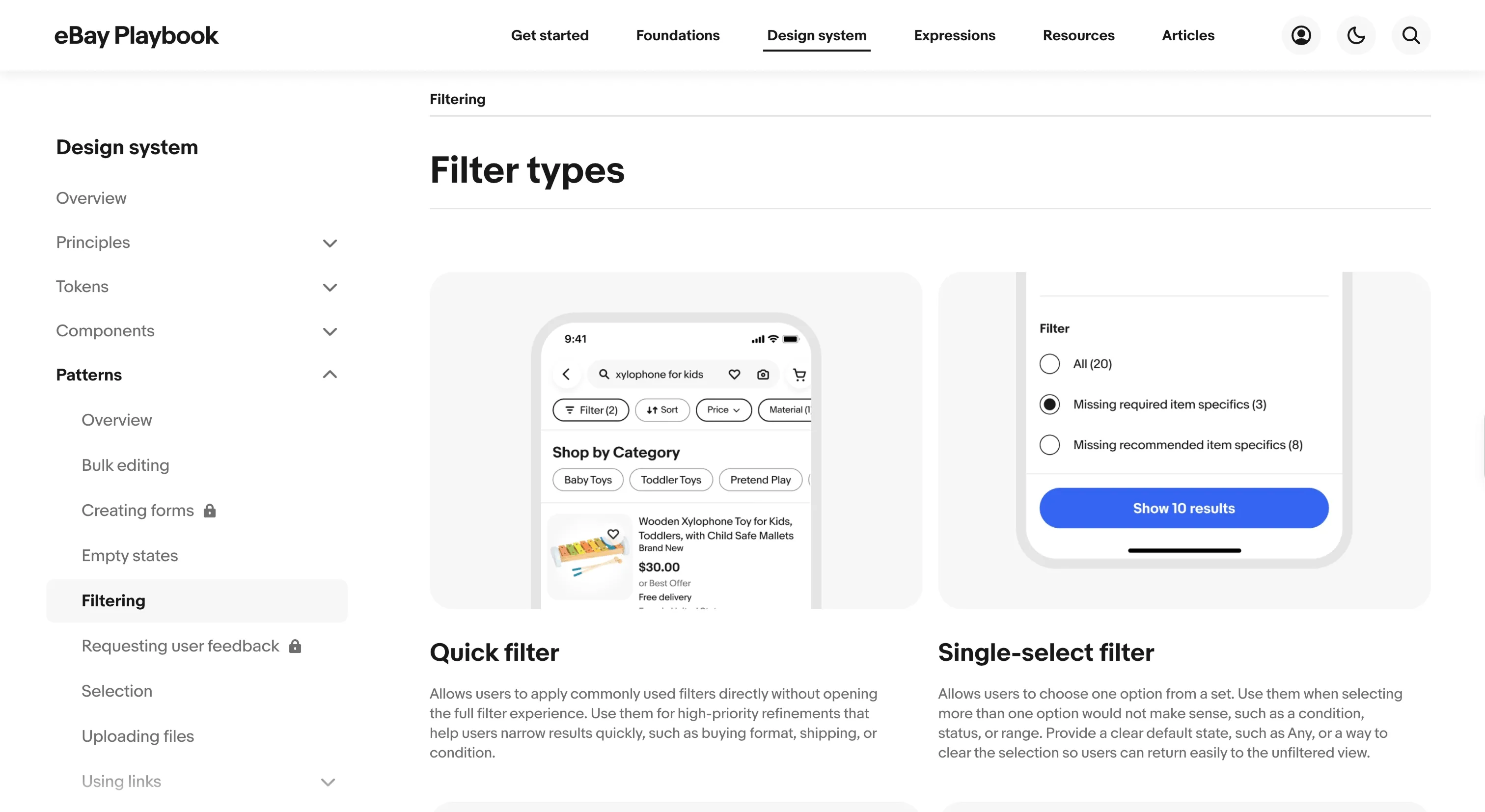
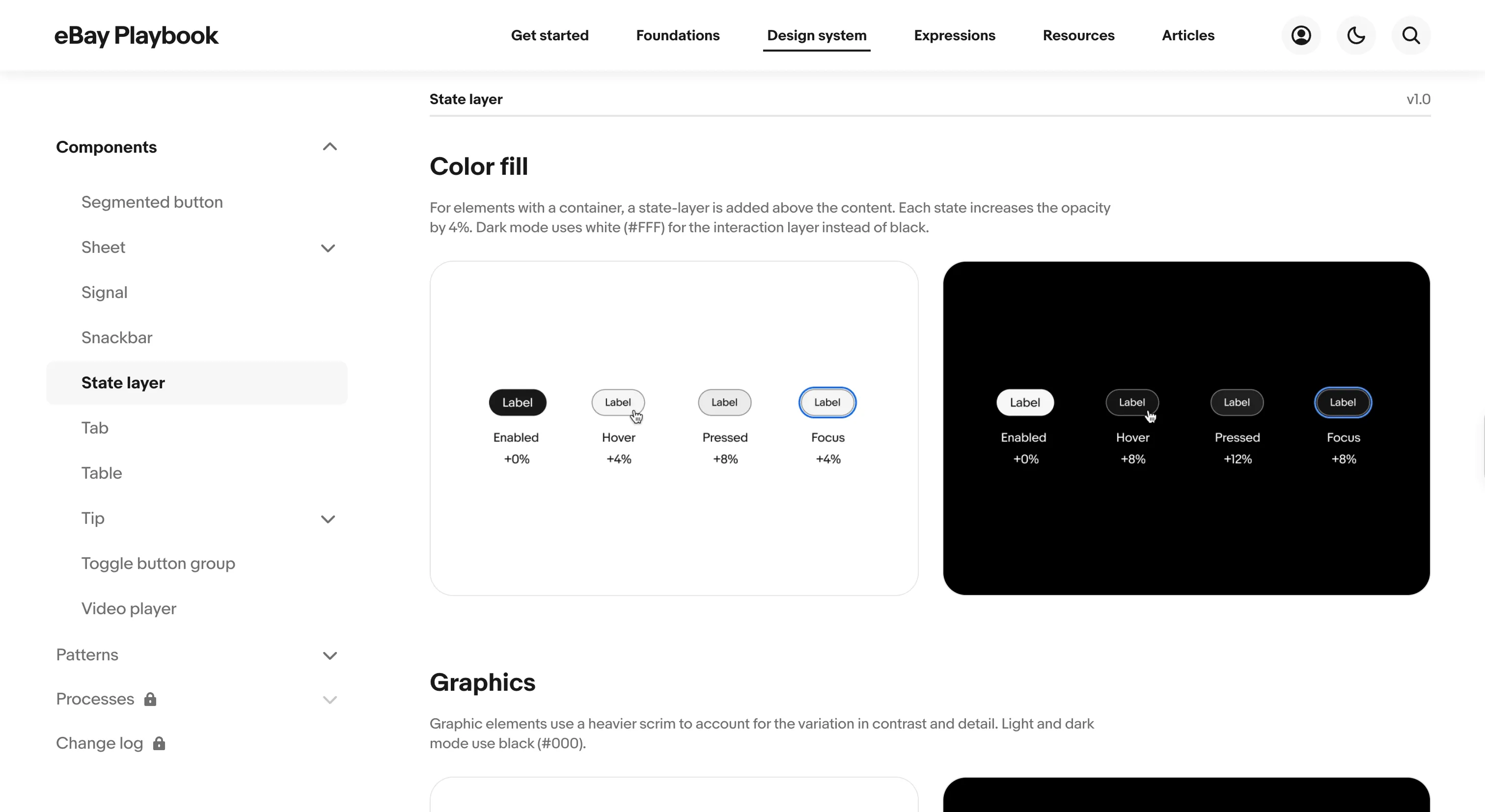
eBay's brand and design system, documented in the heavily-automated eBay Playbook where design, brand, engineering, and accessibility live in one place, published straight from Figma.
Why we like it
Evo is the best worked example we know of a design-system pipeline that's actually automated. eBay's own case study describes a Figma plugin that lints pages, checks accessibility content and publishes docs straight to the CMS, so designers ship updates without engineering, plus a component status API that registers each component by canonical name and version and shows real-time availability across platforms.
The system underneath is three layers off one CSS source of truth: skin (CSS and BEM), Marko components and React components, stated as WCAG 2.2 AA aligned and tested at 400% zoom, with assistive tech and right-to-left support. The live Playbook even shows a status matrix across CSS, Marko and React, with a version per component per platform.
Where it fits
Evo fits very large, multi-framework orgs, eBay runs both Marko and React, that need one CSS foundation, cross-platform status tracking and strong accessibility, and whose teams already author in Figma. It's mid-migration (Marko 5 to 6, legacy React to React 19), so expect some parts in flight.
Ideas to borrow
- 01.
Documentation
Publish a live, per-platform component status matrix, build state and version for each of CSS, Marko and React, so consumers see exactly what's ready where instead of guessing.
- 02.
Process/automation
A Figma plugin that lints pages and publishes docs straight to your CMS closes the design-to-docs gap that process documentation never quite does.